← Back to Projects

Structured & Multimodal AI for Healthcare

Studying how heterogeneous clinical evidence can retain its structure and patient-specific relevance before being integrated for prediction or report generation.

My recent healthcare research spans multimodal EHR prediction and medical vision-language generation. Across these settings, I study how clinically meaningful distinctions can be preserved long enough for a model to determine which evidence is relevant to the downstream task.

2024 — Present Patient ModelingClinical ReasoningMedical Vision-Language Generation
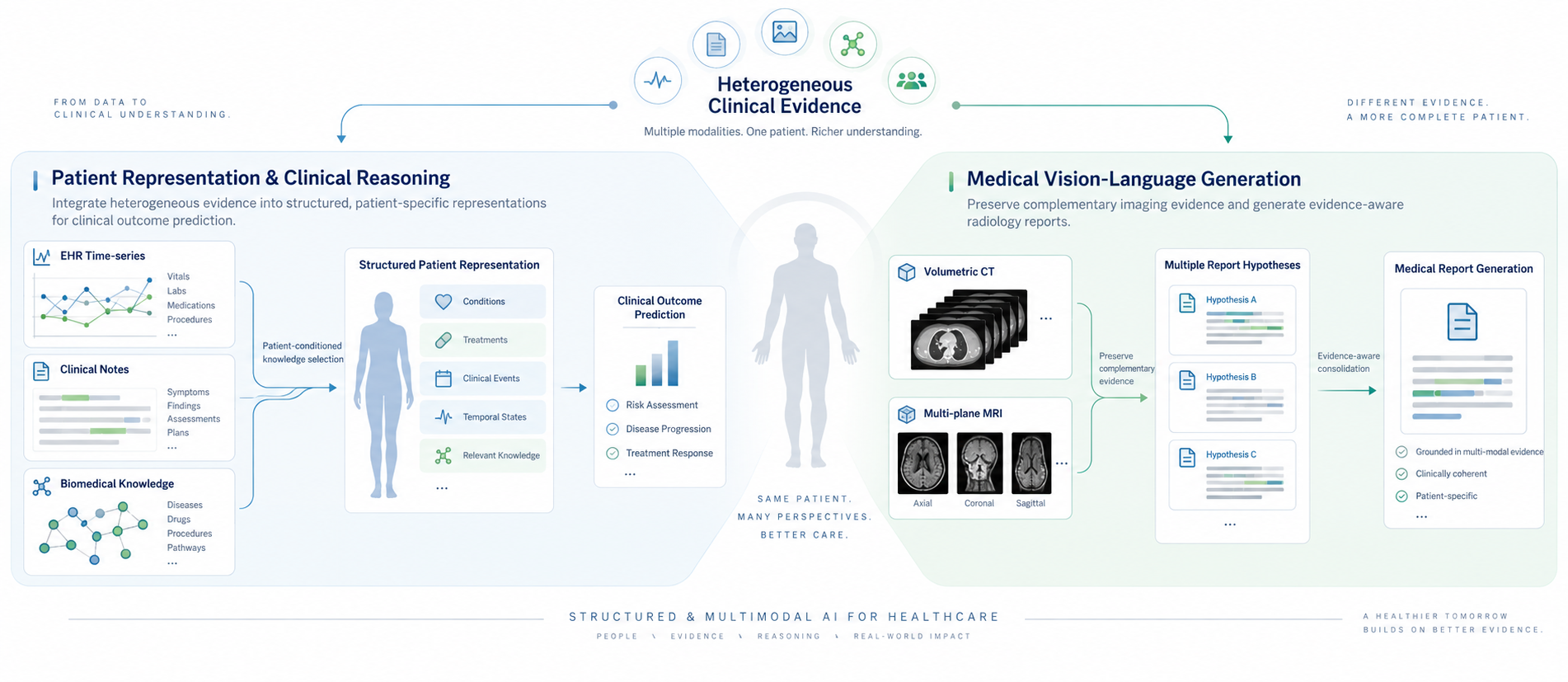
Heterogeneous clinical evidence branches into patient representation and clinical reasoning on one side, and medical vision-language generation on the other.

From Heterogeneous Clinical Evidence to Patient-Specific Reasoning

Healthcare data combine signals with very different structure: physiological measurements evolve over time, clinical notes describe patient state and treatment response, biomedical knowledge adds external context, and medical images provide spatial evidence across views and modalities.

My work asks when these sources should remain distinct, how their relevance should be determined, and when they should be integrated.

How should heterogeneous clinical evidence be represented and selectively integrated without prematurely collapsing distinctions that matter for clinical prediction and generation?

Patient Representation & Clinical Reasoning

Clinical outcome prediction requires more than combining modalities. The representation should preserve which observations describe different aspects of patient state, which relations connect clinical events, and which external knowledge is actually supported by the current patient record.

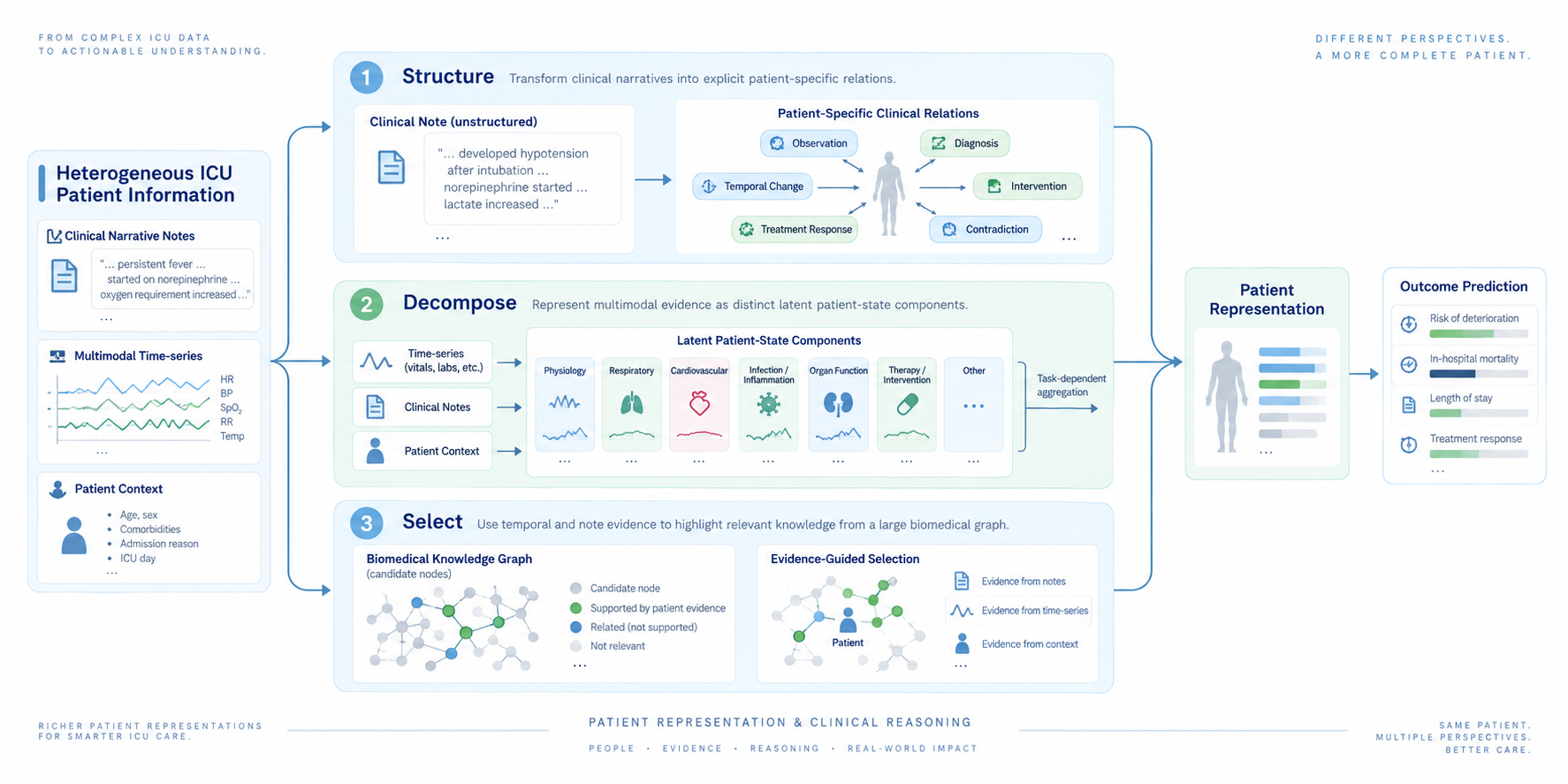
Clinical notes, multimodal EHR, and an external knowledge graph feed three parallel capabilities — structure, decompose, select — that converge on a patient representation used for outcome prediction.
01

Making Clinical Relationships Explicit

STRUCTURE · Clinical narratives → explicit relations

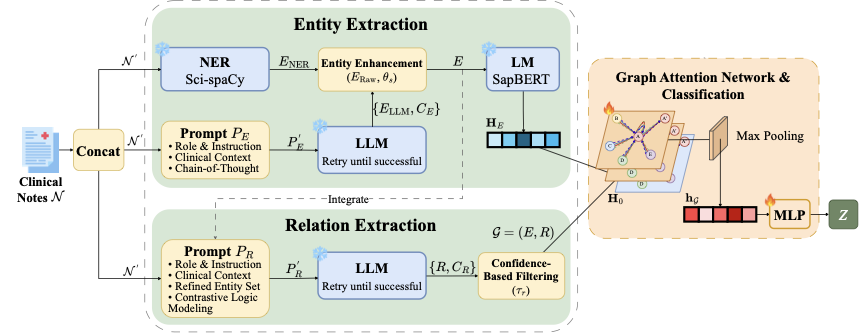
Clinical notes describe temporal changes, treatment responses, contradictions, diagnoses, and interventions, but sequence representations leave many of these relationships implicit. HERMES constructs patient-specific knowledge graphs from clinical narratives so that clinically meaningful relations become explicit before outcome prediction.

  • · Across MIMIC-III and MIMIC-IV mortality and readmission prediction, the graph-based representations outperform the evaluated text-only baselines.
  • · Clinical narratives can become more informative when important patient dynamics are represented explicitly rather than left entirely implicit in a token sequence.
02

Beyond a Single Fused Patient Representation

DECOMPOSE · Multimodal observations → patient-state components

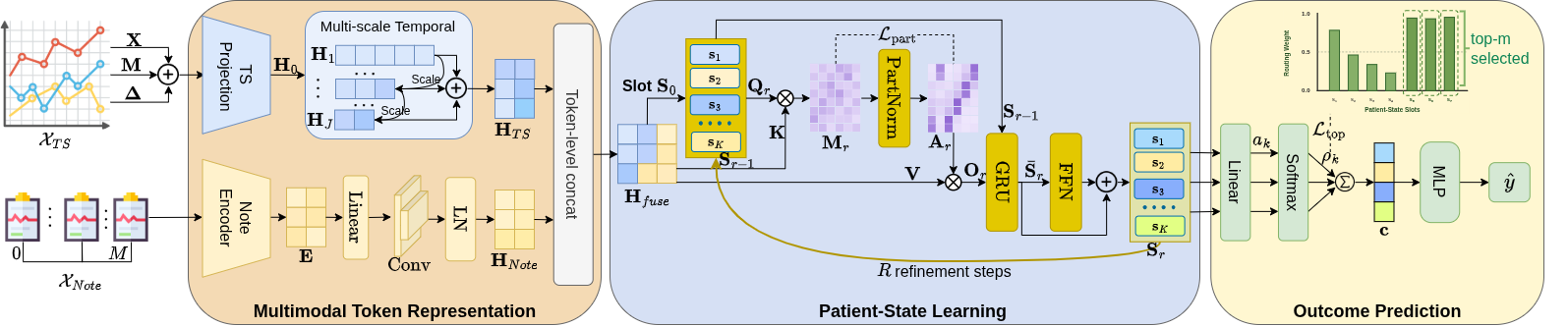
Multimodal EHR models often aggregate heterogeneous observations into a compact patient representation before their task-specific contributions are known. MCPL instead learns multiple latent patient-state components from time-series and clinical-note evidence and keeps them separate until outcome-dependent aggregation.

  • · Higher-weighted components retain more predictive information than random components, and removing different components changes mortality and readmission predictions by different amounts.
  • · Patient state does not have to be represented by one monolithic embedding before the model determines what matters for the target outcome.
03

Connected Knowledge Is Not Necessarily Patient-Relevant Knowledge

SELECT · External knowledge → patient-supported knowledge

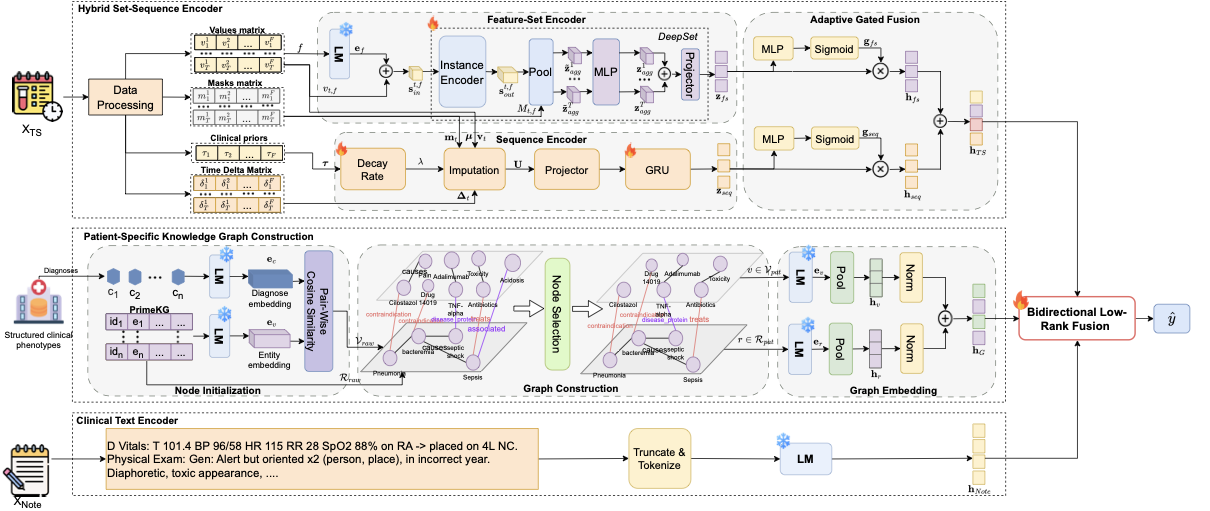
Biomedical knowledge graphs can expand observed clinical concepts into many connected candidates, but connectivity alone does not show which knowledge is supported by the current ICU record. PIKE uses temporal and note evidence to select patient-supported knowledge before integrating it with the original EHR representations.

  • · The ongoing study evaluates patient-evidence-guided knowledge selection under sparse and incomplete clinical observations, with a larger advantage when observed evidence becomes sparse or the observation window becomes shorter.
  • · External knowledge should be selected from current patient evidence, not treated as relevant simply because it is graph-connected.

Medical Vision-Language Generation

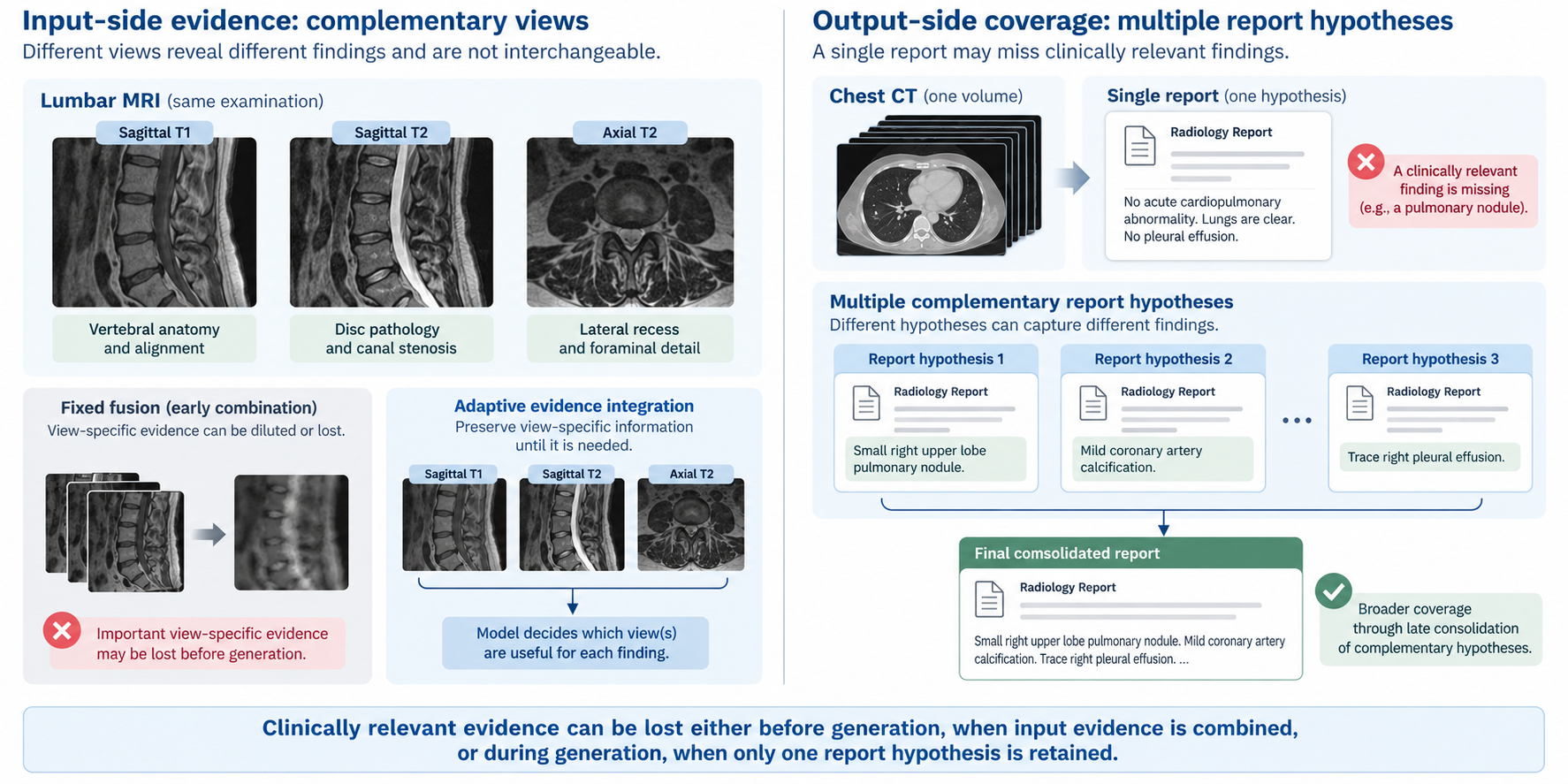
Clinically relevant information can be lost at two different points in report generation: before decoding, when complementary imaging evidence is combined, and during decoding, when a single report hypothesis omits a finding.

Input-side evidence loss when complementary imaging views are combined, and output-side coverage loss when only one report hypothesis is retained.
01

Different Views Carry Different Diagnostic Evidence

ADAPT · Multiple imaging views → content-dependent fusion

Lumbar MRI contains complementary sequences and imaging planes. Sagittal views capture longitudinal anatomy, while axial images provide per-level geometry that is important for several findings. GateSPINE preserves sagittal and axial evidence as separate representations and combines them with content-adaptive cross-view fusion before report generation.

  • · The strongest clinical-efficacy performance among the evaluated methods across three datasets, with gains largely driven by recall. The cross-view mechanism is evaluated only on cohorts containing both sagittal and axial imaging.
  • · Complementary imaging views should remain distinguishable until the model can determine which evidence is useful for the current finding.
02

A Single Generated Report Can Miss Clinically Relevant Findings

CONSOLIDATE · Multiple report hypotheses → clinical coverage

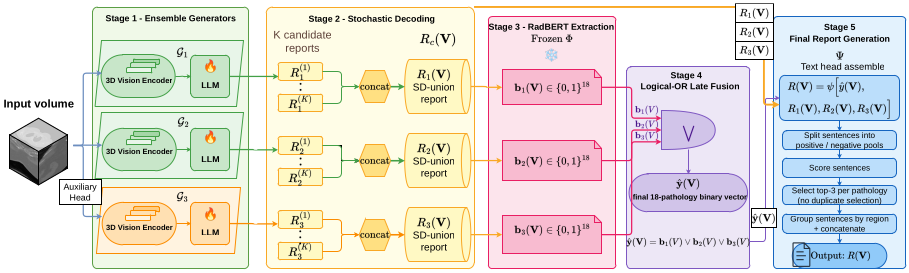
Standard 3D CT report generators typically retain one decoding path, which can create a recall bottleneck when clinically relevant pathologies are omitted. MDEF preserves multiple report hypotheses and consolidates their complementary pathology evidence before producing one final report.

  • · Large recall gains over the strongest evaluated single-report baseline across in-distribution, cross-dataset, and cross-institution evaluation, distributed across many pathology classes — though the gain is recall-driven and comes with a precision trade-off.
  • · Multiple hypotheses can improve clinical coverage, but completeness must be balanced against precision.

What These Studies Collectively Suggest

01

Preserve structure before aggregation

Clinically meaningful distinctions can exist between relations, latent patient states, external knowledge candidates, imaging views, and generated hypotheses.

02

Make relevance context-dependent

Different outcomes, patients, findings, and evidence sources can require different weighting or selection.

03

Evaluate clinical information directly

Predictive discrimination, clinical findings, recall, and qualitative error analysis can reveal behavior that surface-level text similarity alone does not capture.

Research Outputs

5 works

Accepted The 15th Conference on Information Technology and its Applications (CITA 2026) · 2026

HERMES: Contrast-Aware Knowledge Graph Reasoning from Clinical Notes for Patient Outcome Prediction

Gia-Bach Nguyen, Tuan-Cuong Vuong, Trang Xuan Mai, Duy Quoc Ngo, Tien-Cuong Nguyen, Huan Vu, Thien Luong Van

Preprint Preprint · 2026

MCPL: Learning Multi-Component Patient Representations from Multimodal ICU Records for Early Clinical Outcome Prediction

Tuan-Cuong Vuong, Trang Xuan Mai, Tien-Cuong Nguyen, Trong-Nghia Nguyen, Thien Van Luong

Preprint Preprint · 2026

PIKE: Patient-Context Informed Knowledge Graph Enrichment for ICU Outcome Prediction

Tuan-Cuong Vuong, Trang Xuan Mai, Son Thai Mai, Duong Tung Ta, Vu-Duc Ngo, Tien-Cuong Nguyen, Huan Vu, Thien Van Luong

Preprint Preprint · 2026

GateSPINE: Gated Cross-View Fusion for Lumbar Spine MRI Report Generation

Hoang Nguyen Van, Tuan-Cuong Vuong, Trang Mai Xuan, Bien Tran Van, Van-Dem Pham, Thien Luong Van

Preprint Preprint · 2026

MDEF: Multi-Report Deep Ensemble Fusion for 3D CT Report Generation

Tung Duong Ta, Tim Oates, Manas Gaur, Trong-Nghia Nguyen, Tien-Cuong Nguyen, Tuan-Cuong Vuong, Mai Xuan Trang, Thien Van Luong

Current Research Frontier

My current work is moving from global multimodal conditioning toward patient- and region-specific relational reasoning for medical report generation. The question is no longer only whether additional information improves generation, but whether explicit relationships among clinical context, anatomical regions, and current imaging evidence provide value beyond strong non-relational multimodal representations.

When do explicit patient-specific relationships add information that strong multimodal conditioning cannot recover implicitly?

Related Projects

Interested in this research direction or a PhD collaboration?

Start a conversation