← Back to Projects

Language Systems for Multi-Source Reasoning

From hybrid content selection and generation to knowledge-grounded multi-agent coordination.

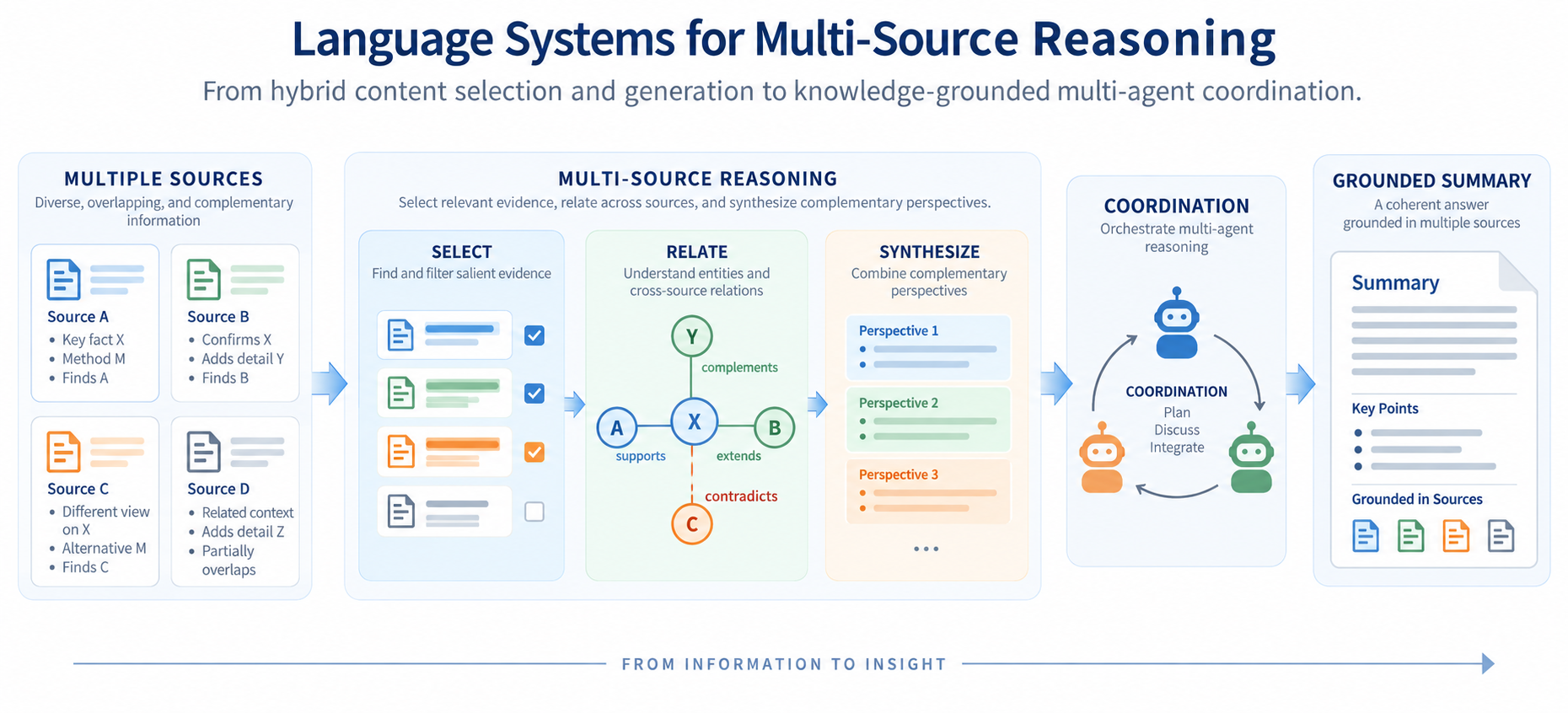
I study how language systems synthesize information across multiple sources by preserving salient evidence, modeling cross-source relationships, and coordinating complementary reasoning strategies.

2024 — Present Natural Language ProcessingMulti-Agent SystemsKnowledge GraphsLarge Language Models
Multiple source documents are selected, related, and synthesized into a grounded summary.

The Research Problem

Multi-document summarization requires more than compressing long text. A system must determine which information matters across sources, reduce redundancy, preserve important details, and reconcile complementary or potentially conflicting perspectives.

My work in this direction progresses from hybrid content selection and generation toward structured multi-source reasoning and adaptive coordination.

How can language systems synthesize information across multiple sources while preserving salient evidence and explicitly reasoning over relationships among them?

Research Evolution

An evolving research question, from content selection to structured multi-source reasoning.

01

Hybrid Content Selection & Generation

01 · 2024

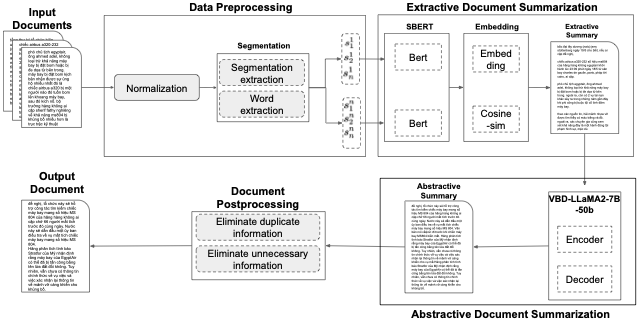
Separate what to preserve from how to express it. BERT-VBD proposes a two-component framework for Vietnamese multi-document summarization: an extractive stage using SBERT to select salient sentences, followed by an abstractive stage using VBD-LLaMA2 to generate the final summary.

  • · Reported ROUGE-1 F1 of 70.1 and ROUGE-2 F1 of 39.6 on VN-MDS in comparative evaluation.
  • · Hybrid selection-before-generation is a useful foundation for preserving salient information while improving readability.
02

Knowledge-Grounded Multi-Agent Coordination

02 · 2026

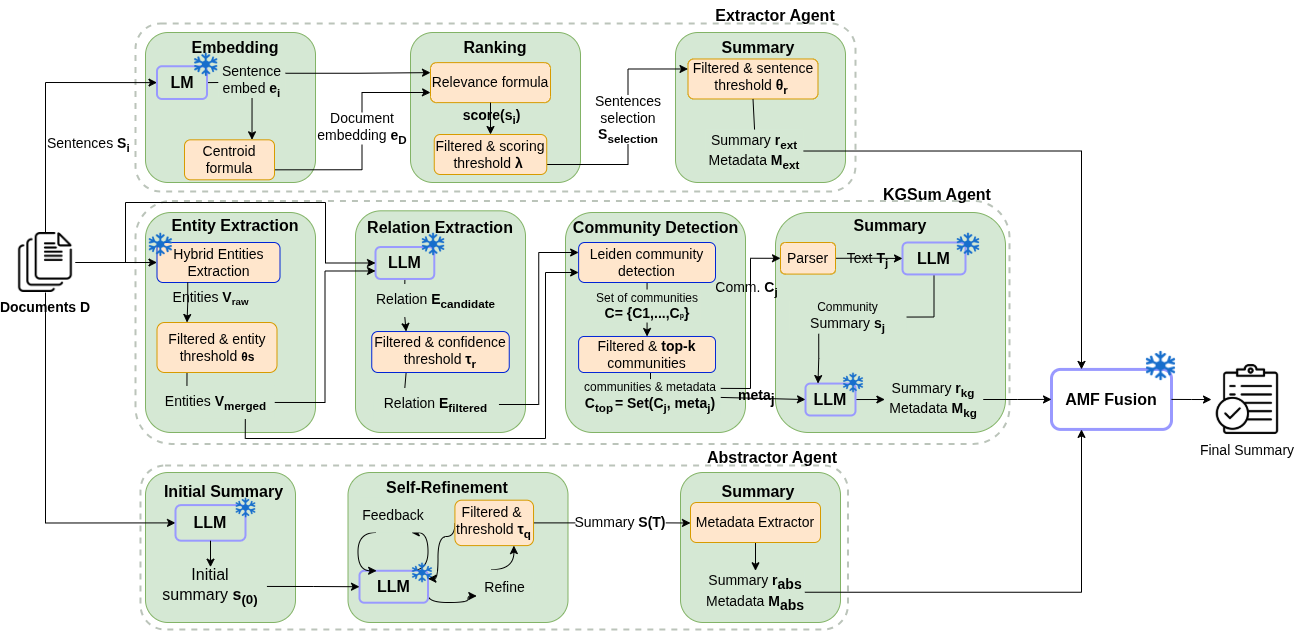
Reason from complementary perspectives before synthesizing the final answer. The Mixture-of-Agents (MoA) framework moves from a sequential pipeline to three specialized perspectives — an Extractor for salient evidence, a KGSum agent modeling entities and relations, and an Abstractor for fluent synthesis — combined via Adaptive Multi-perspective Fusion (AMF), which weighs the quality and consistency of each perspective before synthesis.

  • · In the reported ablations, KGSum is the strongest standalone agent, multi-agent combinations outperform individual agents, and the full MoA framework performs best overall.
  • · The line evolves from selecting salient content to coordinating complementary reasoning perspectives grounded in explicit cross-source structure.

What the Experiments Suggest

01

Relations matter

KGSum is the strongest standalone agent in the reported ablation.

02

Complementarity matters

Multi-agent combinations consistently outperform individual agents.

03

Coordination matters

The full MoA framework achieves the best performance among the reported ablations.

Research Outputs

2 works

Published Neural Computing and Applications · 2026

A training-free mixture-of-agents framework for multi-document summarization using LLMs and knowledge graphs

Tuan-Cuong Vuong, Trang Xuan Mai, Tien-Cuong Nguyen, Vu-Duc Ngo, Thien Van Luong

Published CITA 2024 · 2024

BERT-VBD: Vietnamese Multi-Document Summarization Framework

Tuan-Cuong Vuong, Mai Xuan Trang, Luong Van Thien

Current Frontier

I am interested in extending this line from task-specific summarization toward more general multi-source language systems that can dynamically select evidence, construct structured representations, and coordinate complementary reasoning strategies.

Do agent specialization and structured knowledge provide reliable benefits beyond a single task or domain?

Related Projects

Interested in this research direction or a PhD collaboration?

Start a conversation