← Back to Projects

Traffic Representation for Network Intrusion Detection

From feature reduction to learned and language-based representations for efficient intrusion detection.

My research in network intrusion detection studies how network traffic should be represented — from selecting and compressing numerical features to learning latent and semantic representations — to support accurate and increasingly data-efficient attack detection.

2022 — Present Network SecurityMachine LearningRepresentation LearningLarge Language Models
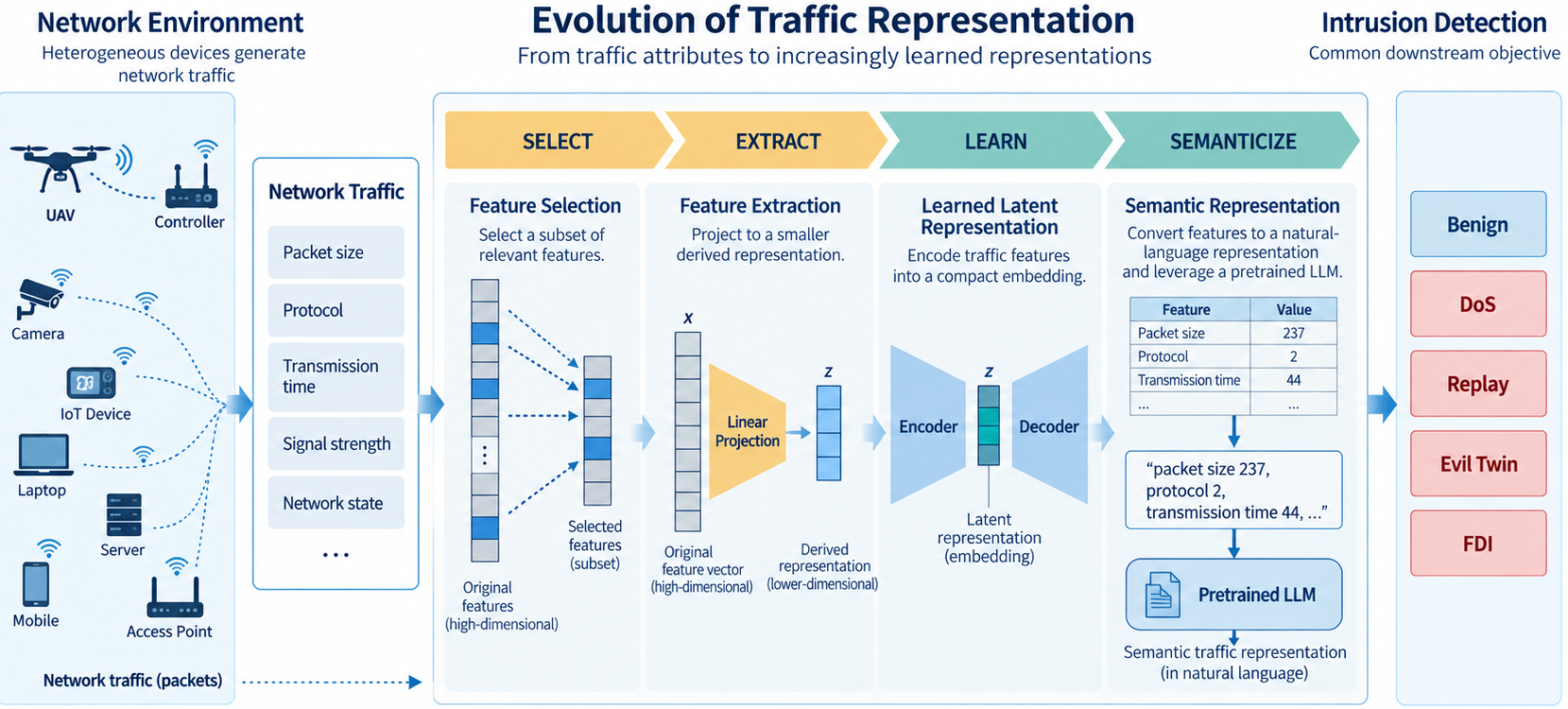
Evolution of traffic representation across this research line: from feature reduction to learned latent representations and semantic representations for pretrained language models.

The Research Problem

Network traffic records can contain many heterogeneous, redundant, or weakly informative attributes. Preprocessing can increase this dimensionality further, making both detection effectiveness and computational cost sensitive to how information is represented before classification.

My research started by studying this representation bottleneck in conventional machine-learning-based intrusion detection. It subsequently moved toward nonlinear learned representations on real UAV network traffic and, more recently, toward transforming structured traffic into semantic text that can be processed by pretrained language models.

How should network traffic be represented to preserve attack-relevant information while controlling computational and labeled-data requirements?

Across these studies, the representation problem progressively changes from deciding which traffic attributes to retain, to learning compact latent representations, and finally to asking whether structured traffic can be expressed semantically for pretrained models.

SELECT

Feature Selection

EXTRACT

PCA-based Feature Extraction

LEARN

Autoencoder Latent Representation

SEMANTICIZE

Traffic Serialization + LLM

Research Evolution

Rather than treating each publication as an isolated project, this research line can be understood through three successive questions about how information should be represented for intrusion detection.

01

Understanding Feature-Reduction Trade-offs

01 · 2022 — 2024

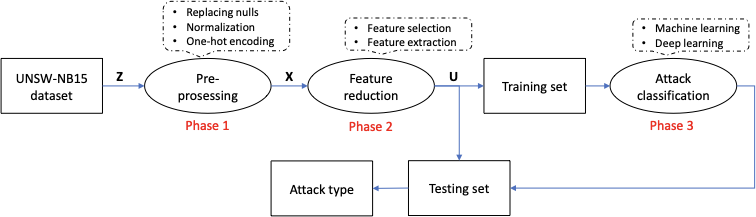
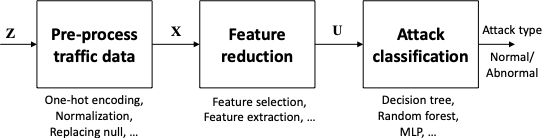
Classical intrusion-detection pipelines often reduce traffic dimensionality before classification, but feature selection and feature extraction preserve information in fundamentally different ways. We compared correlation-based feature selection with PCA-based feature extraction under controlled representation sizes, evaluating detection quality together with training and inference cost. A journal extension (Ngo et al., Cluster Computing, 2024) added systematic analysis across binary and multiclass settings and derived scenario-dependent guidance.

  • · Feature selection generally performs better and faster when the retained dimensionality K is sufficiently large, whereas extraction becomes advantageous when K is very small and is less sensitive to K.
  • · No single feature-reduction strategy dominates across all operating conditions — the preferred representation depends on the dimensionality budget, computational constraints, and attack-class diversity.
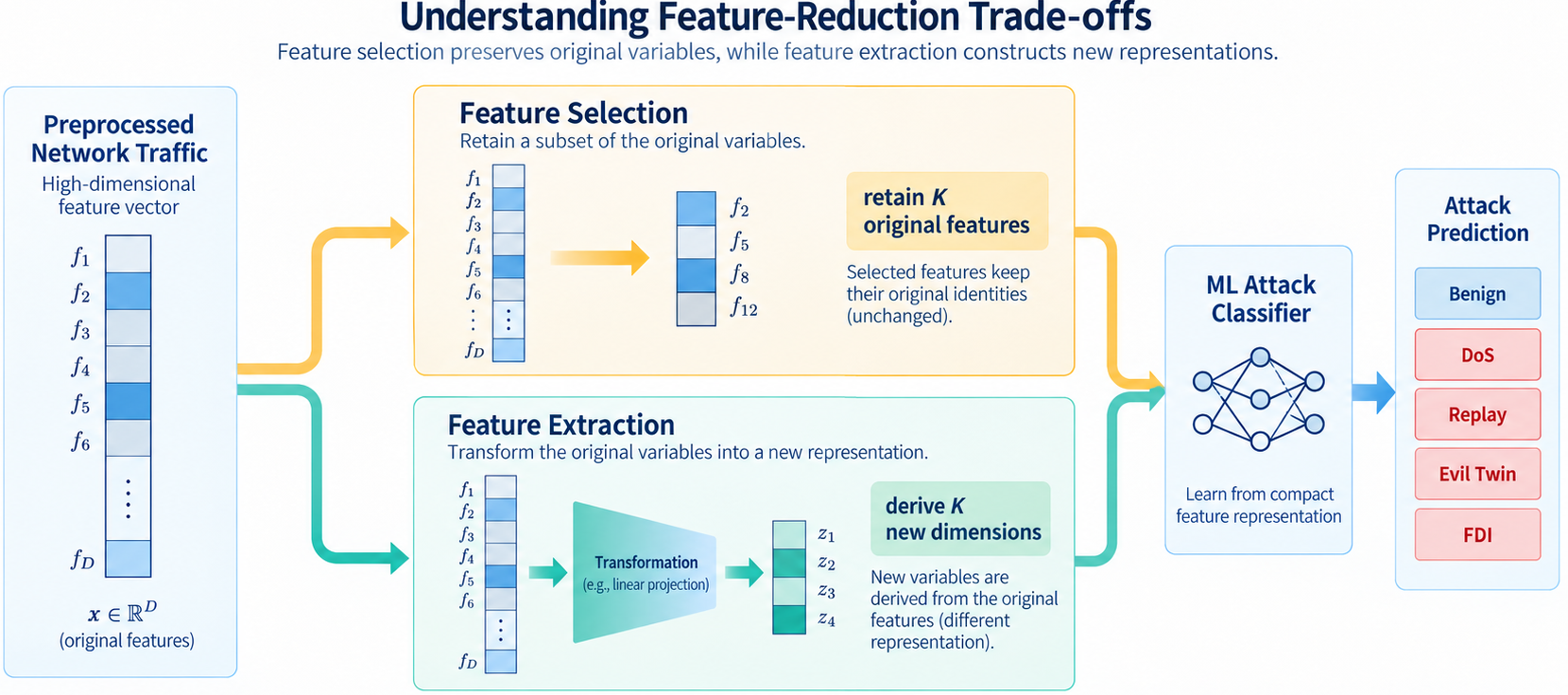
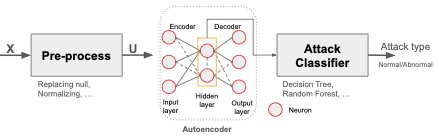
Feature selection retains a subset of original traffic attributes, whereas feature extraction derives a compact representation before attack classification.
02

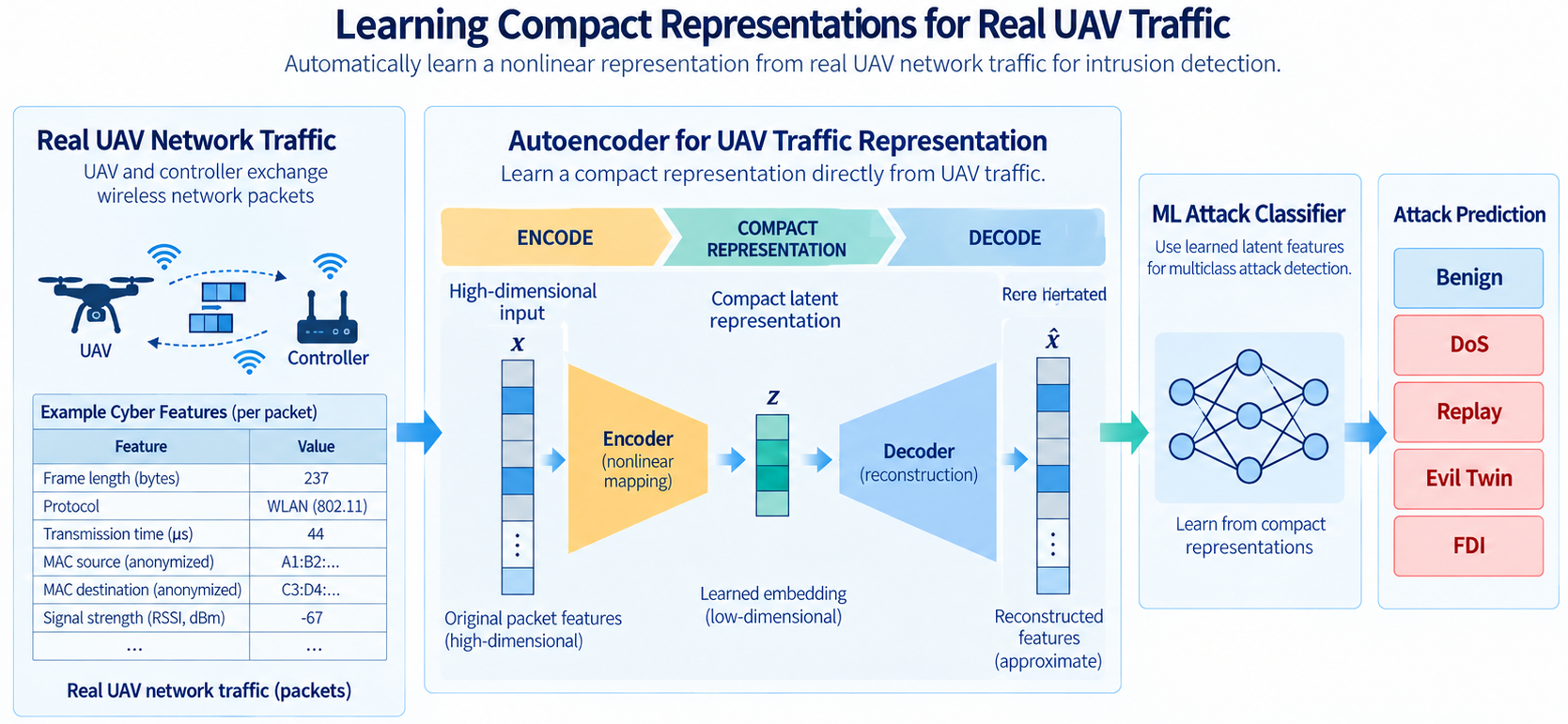
Learning Compact Representations for Real UAV Traffic

02 · 2024

Fixed feature-selection rules and linear projections constrain how traffic information can be compressed, and many prior studies relied on simulated or non-UAV datasets. We introduced an autoencoder-based representation pipeline that learns a compact latent encoding of preprocessed UAV network traffic, evaluated on actual UAV intrusion traffic with benign behavior and four attack classes (DoS, Replay, Evil Twin, False Data Injection).

  • · With eight extracted features, the autoencoder-based system reached 84.09% multiclass F1, compared with 80.15% and 80.89% for the two feature-selection baselines evaluated in the study.
  • · The learned autoencoder representation improved multiclass detection over the feature-selection baselines evaluated on real UAV traffic.
Autoencoder-based feature extraction learns a compact representation of real UAV network traffic before downstream attack classification.
03

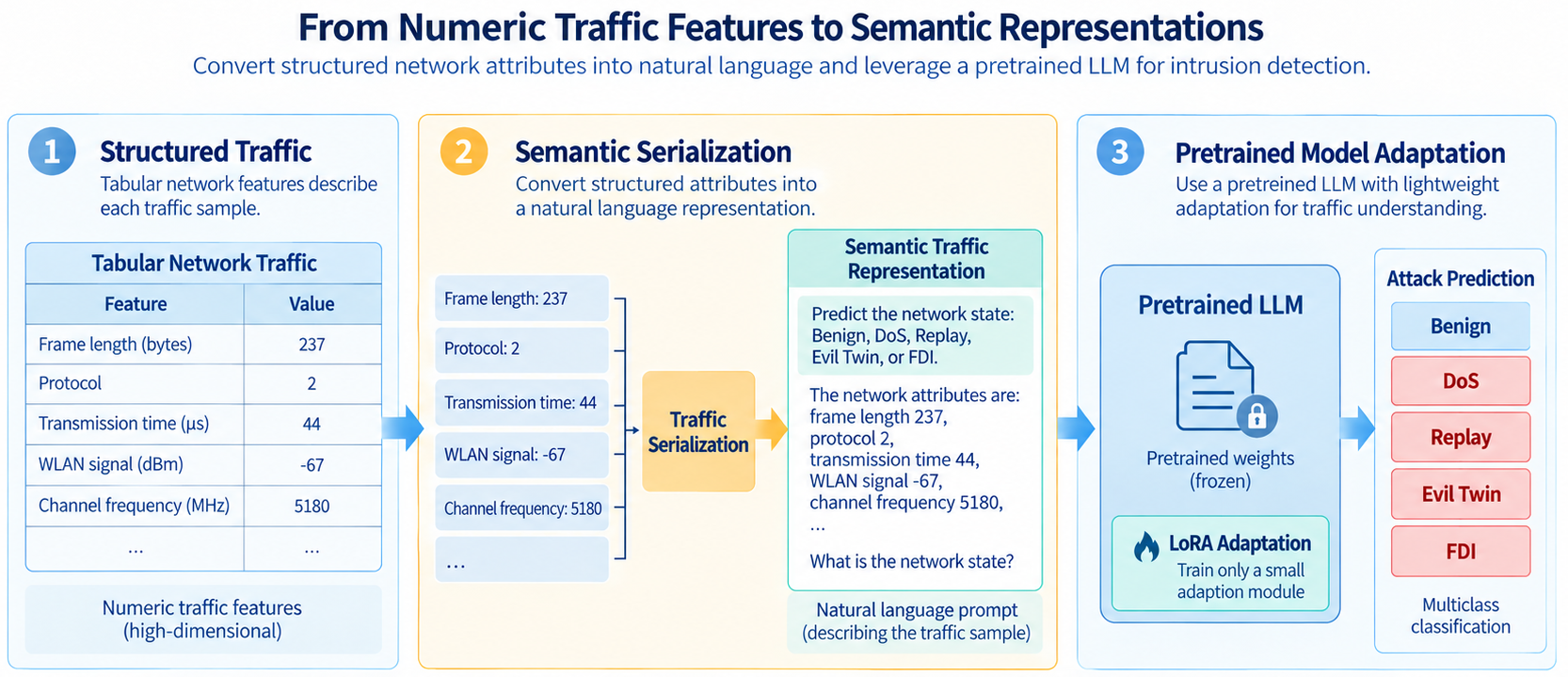
From Numeric Traffic Features to Semantic Representations

03 · 2025 — 2026

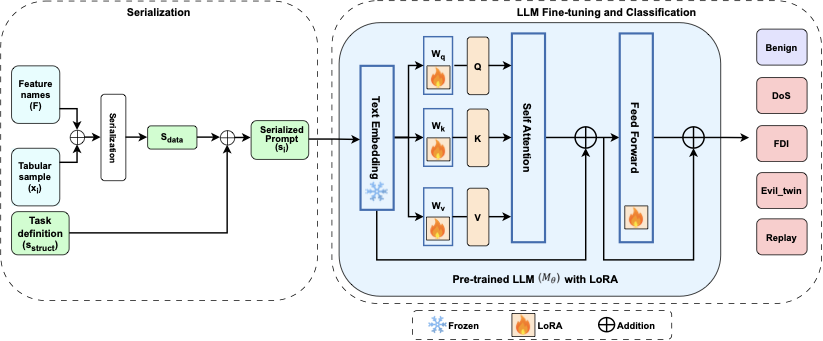
Conventional supervised intrusion detectors remain dependent on task-specific labeled data. We reformulate tabular intrusion detection as an instruction-following problem: traffic feature names and values are serialized into a structured natural-language prompt, and a pretrained language model is adapted with LoRA to predict the attack class.

  • · In the reported UAV-ID experiments, the instruction-tuned LLM reached a macro F1-score of 91.06% with 5,000 training samples, outperforming the evaluated ML/DL baselines under both matched-data and larger-data comparisons.
  • · Once structured network attributes are serialized into language, intrusion detection can exploit pretrained representations rather than learning exclusively from task-specific numeric samples.
Structured traffic attributes are serialized into language and used to adapt a pretrained language model for UAV intrusion classification.

What This Research Line Suggests

01

Representation strategy depends on the operating regime.

The appropriate form of feature reduction depends on the dimensionality budget, computational constraints, and diversity of attack behaviors rather than on a universally superior method.

02

Domain-specific traffic motivates learned representations.

Moving from generic IoT benchmarks toward actual UAV traffic creates a stronger case for learning compact representations directly from the observed data rather than relying only on fixed reduction rules.

03

Pretraining changes the representation problem.

Once structured network attributes are serialized into language, intrusion detection can exploit pretrained representations rather than learning exclusively from task-specific numeric samples.

Research Outputs

4 works

Preprint Preprint · 2026

LLM-Powered Intrusion Detection Systems for Unmanned Aerial Vehicles

Cong Chi Nguyen, Tuan-Cuong Vuong, Mai Xuan Trang, Huan Vu, Vu-Duc Ngo, Thien Van Luong

Published NOLTA 2024 · 2024

Effective Intrusion Detection for UAV Communications using Autoencoder-based Feature Extraction and Machine Learning Approach

Tuan-Cuong Vuong, Cong Chi Nguyen, Van-Cuong Pham, Thi-Thanh-Huyen Le, Xuan-Nam Tran, Thien Van Luong

Published Cluster Computing · 2023

Machine learning-based intrusion detection: feature selection versus feature extraction

Vu-Duc Ngo, Tuan-Cuong Vuong, Thien Van Luong, Hung Tran

Published APSIPA ASC 2022 · 2022

A Comparison of Feature Selection and Feature Extraction in Network Intrusion Detection Systems

Tuan-Cuong Vuong, Hung Tran, Mai Xuan Trang, Vu-Duc Ngo, Thien Van Luong

Current Frontier

The most recent work in this research line explores whether pretrained language models can reduce dependence on large task-specific labeled datasets for intrusion detection. A remaining challenge is that representing structured traffic as language introduces context-length and computational costs, particularly when richer examples or longer traffic context are required.

This points toward more efficient traffic serialization, context compression, and resource-aware use of pretrained models as natural directions for extending this line of research.

Related Projects

Interested in this research direction or a PhD collaboration?

Start a conversation